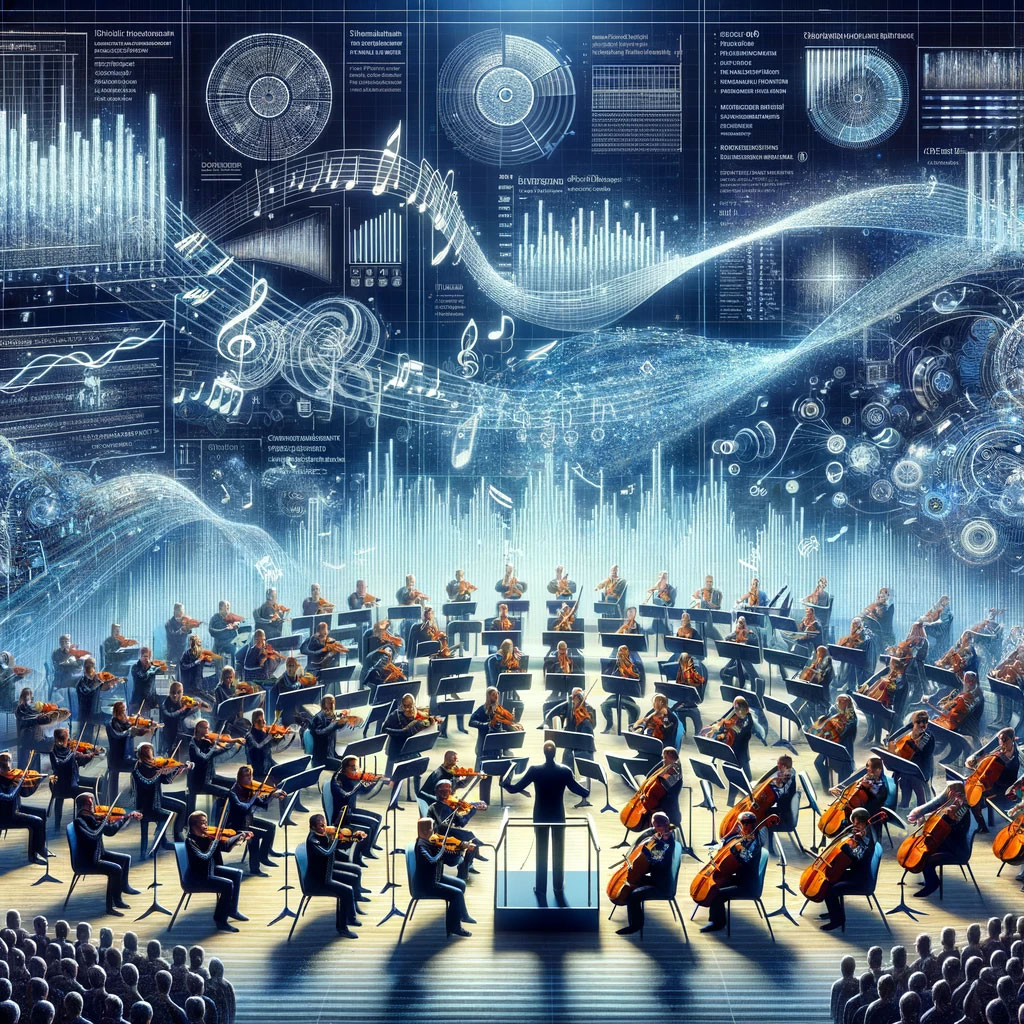
Welcome back to our engaging journey through the world of Artificial Intelligence (AI) and Machine Learning (ML)! So far, we’ve navigated through foundational concepts like neural networks, deep learning, and transfer learning, illustrating how AI mimics human learning processes. Today, we dive into a fascinating AI strategy known as Ensemble Learning. Let’s simplify this concept by comparing it to a well-coordinated orchestra, highlighting its power, applications, and what the future holds.
Understanding Ensemble Learning
Imagine an orchestra, where each musician plays a unique instrument, contributing to a harmonious performance. No single instrument carries the entire melody, but together, they create a rich, full sound. Ensemble Learning in AI works similarly. Instead of relying on a single model to make predictions, Ensemble Learning combines multiple models to improve accuracy and reduce the likelihood of error. This method leverages the strength and diversity of various models, like different instruments in an orchestra, to achieve a more robust and reliable outcome.
Ensemble Learning begins with the training of multiple machine learning models on the same dataset. These models could range from simple decision trees to complex neural networks. Once trained, their predictions are combined, either by voting (for classification tasks) or averaging (for regression tasks). The underlying idea is that, while each model may have its weaknesses, the aggregation of their predictions leads to a more accurate and stable consensus, much like how blending the sounds of different instruments enhances the overall music quality.
Ensemble Learning in Action
Fraud Detection: Financial institutions use Ensemble Learning to detect fraudulent transactions. By combining predictions from various models, they can identify suspicious activities with higher accuracy, minimizing false positives and negatives.
Weather Forecasting: Ensemble methods are employed to predict weather conditions by aggregating outputs from multiple forecasting models, enhancing the reliability of weather predictions.
Medical Diagnoses: In healthcare, Ensemble Learning helps improve diagnostic accuracy by combining insights from multiple diagnostic tools and tests, offering a more comprehensive assessment of patient conditions.
The Future Potential of Ensemble Learning
The collaborative strength of Ensemble Learning holds promising potential for the future. In autonomous vehicles, combining sensory data from multiple models could lead to safer and more reliable decision-making in complex driving environments. In personalized education, it could aggregate insights from various learning models to tailor educational content to individual student needs more effectively.
Ensemble Learning showcases the power of collaboration in AI, mirroring the harmony of an orchestra. By pooling the wisdom of multiple models, it achieves superior performance, making it a vital strategy in the AI toolkit. As we continue to explore AI’s capabilities, Ensemble Learning stands as a testament to the idea that the whole is greater than the sum of its parts, promising to push the boundaries of what AI can accomplish.
Stay tuned for more insights as we further demystify the world of AI, making complex concepts accessible and engaging for everyone.

 Meadows Cozy Corner
Leave a comment